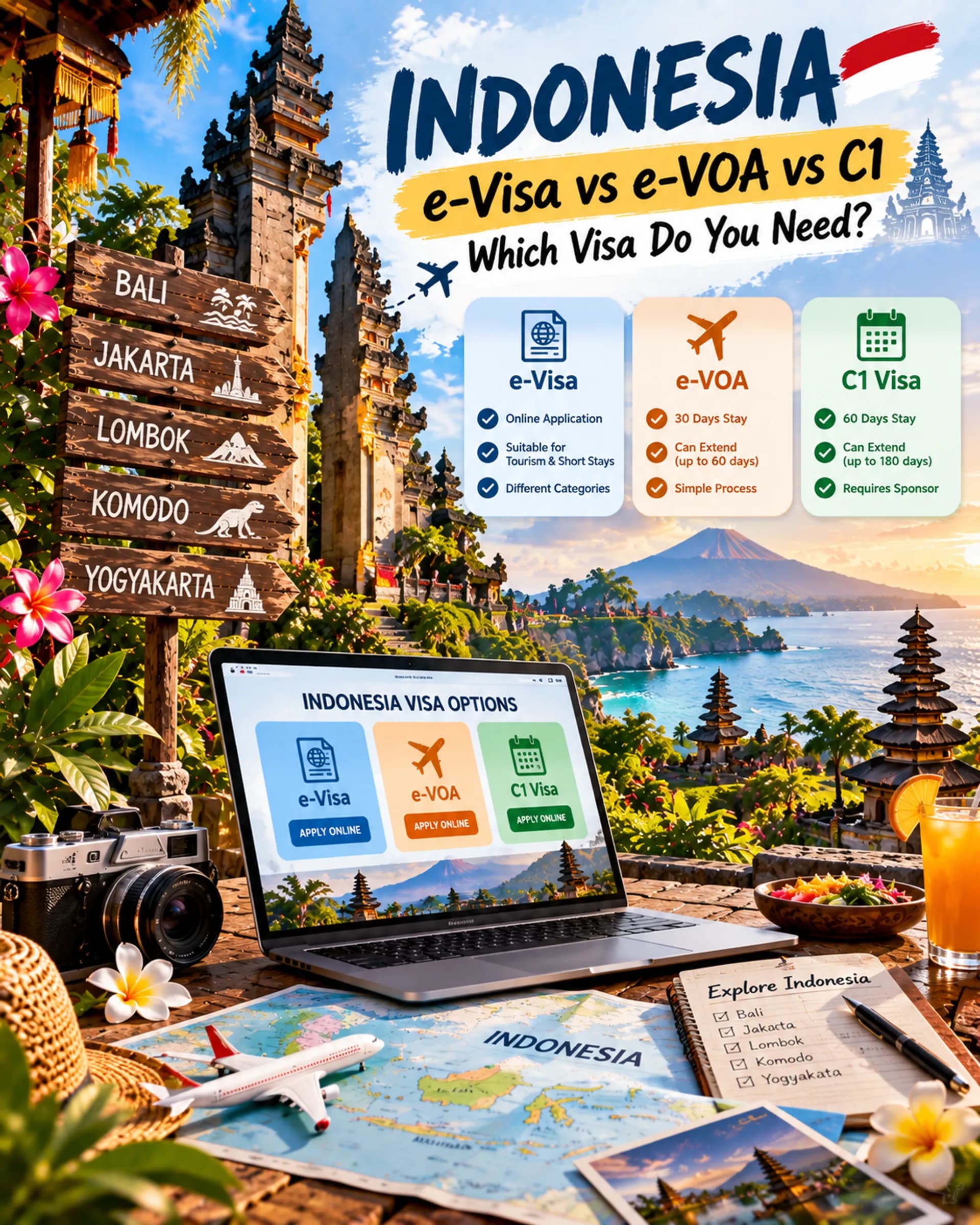
Indonesia e-Visa vs e-VOA vs C1: Which Visa Do You Need in 2026?
Planning a holiday to Bali, Jakarta, Lombok or another Indonesian destination? One of the first questions you may have is: Which Indonesian visa should I apply for?
Indonesia has several visitor visa options, and the terminology can be confusing. The e-VOA, C1 Tourist Visa and other e-Visa categories are not interchangeable.
For many short holidays, an e-VOA may be convenient. For a longer planned stay, the C1 Tourist Visa may be more appropriate. Your nationality, purpose of travel and intended length of stay can all affect which option is suitable.
This guide explains the key differences between Indonesia e-VOA, C1 Tourist Visa and other e-Visa options in 2026.
Indonesia C1 tourist visa vs e-VOA: Quick Comparison
Feature | e-VOA / B1 | C1 Tourist Visa |
|---|---|---|
Main purpose | Short tourism/visitor trips | Tourism and longer visits |
Initial stay | Up to 30 days | Up to 60 days |
Extension | Once for 30 days, up to 60 days total | Can be extended up to 180 days in total |
Entry | Single entry | Single entry |
Sponsor required | No | Yes, for C1 |
Application | Online or on arrival, if eligible | Online through immigration system |
Current B1 fee | Rp500,000 | Rp1,000,000 |
Indonesia's Directorate General of Immigration currently identifies B1 as the Visa on Arrival category for tourism and C1 as a single-entry visitor visa for tourism.
What Is Indonesia e-VOA?
The electronic Visa on Arrival (e-VOA) allows eligible foreign travellers to obtain their Indonesian Visa on Arrival electronically before travelling.
The underlying visa category is B1 Visa on Arrival.
The B1 visa allows an initial stay of up to 30 days from the date of arrival. It can be extended once, allowing a total stay of up to 60 days, subject to the applicable immigration requirements.
One of the main advantages of e-VOA is convenience: eligible travellers can complete the process before arriving rather than relying entirely on the arrival process at the airport.
Current e-VOA cost
The Indonesian immigration authority currently lists the B1 Visa on Arrival fee at:
Rp500,000 for 30 days.
The e-VOA itself is valid for 90 days from issuance, meaning you need to use it within that period.
Who Is e-VOA Best For?
The e-VOA can be a practical option if:
You are eligible for Indonesia's Visa on Arrival.
You are visiting for tourism.
Your initial stay is 30 days or less.
You want the convenience of arranging the visa before arrival.
You may potentially extend your stay once.
However, eligibility depends on nationality and current Indonesian immigration rules.
Always check the current eligible-country list before applying.
What Is the Indonesia C1 Tourist Visa?
The C1 Visa is a single-entry visitor visa that can be used for tourism and certain other permitted visitor activities.
For tourism, it can be particularly useful for travellers planning a longer stay in Indonesia.
The current C1 Tourist Visa provides an initial stay of up to 60 days from the date of arrival. It can be extended several times, with the total stay potentially reaching 180 days, subject to the applicable rules and approvals.
The Indonesian immigration authority currently lists the C1 visa fee as:
Rp1,000,000.
Does C1 Require a Sponsor?
Yes.
Unlike the B1 Visa on Arrival, the current C1 application requires a sponsor/guarantor.
The sponsor must have an account on Indonesia's e-Visa system and submit the application with the required documents.
This makes the C1 process different from e-VOA and is an important factor to consider when choosing between the two.
What Documents Are Required for C1?
Current Indonesian immigration information lists documents including:
Valid travel document/passport
Passport valid for at least six months before expiry
Proof of sufficient living expenses
Recent colour photograph
Sponsor application and declaration documents
The current C1 information also specifies financial evidence equivalent to at least USD 2,000, based on the required bank statement documentation.
Requirements can vary depending on the application circumstances, so applicants should check the latest official requirements before submitting their application.
e-VOA or C1: Which One Should You Choose?
The answer mainly depends on how long you want to stay.
Choose e-VOA if:
Your trip is a short holiday.
You plan to stay up to 30 days initially.
Your passport is eligible for Visa on Arrival.
You do not need a sponsor.
You want a relatively straightforward visitor option.
Consider C1 if:
You are planning a stay longer than 30 days.
You want an initial stay of up to 60 days.
You may need additional extensions.
You meet the C1 requirements.
You have an eligible sponsor.
Example: A 10-Day Bali Holiday
Suppose you are planning:
Bali → 10 days → tourism → return home
If your nationality is eligible for Indonesia's Visa on Arrival, the B1/e-VOA route may be suitable.
There may be little reason to pursue a longer-stay C1 visa for a simple 10-day holiday.
Example: A 50-Day Indonesia Trip
Now imagine your itinerary is:
Bali + Lombok + Java → 50 days
A 30-day e-VOA would not cover the entire planned stay without an extension.
A C1 Tourist Visa may be worth considering because it provides an initial stay of up to 60 days.
The best choice still depends on your nationality, circumstances and current immigration requirements.
Can You Extend an Indonesia e-VOA?
Yes.
The B1 Visa on Arrival can be extended once, bringing the total permitted stay to a maximum of 60 days. For e-VOA holders, the extension can be processed online through the Indonesian immigration system.
However, travellers should not wait until the last minute.
If you think you may need an extension, check the procedure and eligibility requirements before your initial stay expires.
Can You Extend a C1 Tourist Visa?
Yes.
The C1 Tourist Visa can be extended under the applicable Indonesian immigration rules.
Current official information states that the C1 stay can be extended multiple times, up to a maximum total stay of 180 days.
This makes C1 considerably more suitable than e-VOA for travellers planning an extended stay.
What About Other Indonesia e-Visa Categories?
“Indonesia e-Visa” is a broad term.
Indonesia's immigration system contains multiple visa categories for different purposes, including tourism, business, investment, family visits and other activities.
Therefore, it is important not to assume that every Indonesian e-Visa provides the same length of stay or allows the same activities.
For a normal tourist, the most relevant options may include:
B1 Visa on Arrival / e-VOA - short tourism visits.
C1 Tourist Visa - longer tourism stays and extensions.
Other visa categories may apply if your purpose is not ordinary tourism.
Is e-VOA the Same as C1?
No.
Although both can be used for visits to Indonesia, they are separate visa categories with different requirements.
The key differences include:
B1/e-VOA starts with up to 30 days.
C1 starts with up to 60 days.
B1 does not require a sponsor.
C1 requires a sponsor.
B1 can be extended once.
C1 can be extended multiple times under applicable rules.
Is Indonesia e-VOA the Same as Visa-Free Entry?
No.
Indonesia also has visa-exemption arrangements for certain nationalities and circumstances.
If your passport qualifies for visa-free entry, you may not need an e-VOA at all.
This is why travellers should first check:
1. Is my nationality visa-free?
2. If not, am I eligible for Visa on Arrival?
3. If my stay is longer, should I apply for C1 or another visa?
The correct answer depends on your passport and travel purpose.
Important: Visa Eligibility Depends on Nationality
Indonesia's immigration rules are nationality-specific.
Do not assume that because one traveller can obtain an e-VOA, everyone can.
The official Indonesian immigration authority publishes the applicable Visa on Arrival subject list. Current immigration information includes countries such as Australia, India, the United States, Canada, the United Kingdom, China, Japan, South Korea and many others.
Because country eligibility can change, check the current official list before making travel arrangements.
Common Indonesia Visa Mistakes
1. Choosing a visa based only on the destination
Going to Bali does not automatically determine your visa.
Your nationality, purpose and length of stay matter.
2. Confusing e-VOA with C1
Both are visitor options, but their requirements and permitted stay are different.
3. Assuming e-VOA gives 60 days automatically
The initial B1 stay is 30 days. The stay can be extended once to reach a maximum total of 60 days.
4. Applying for C1 without understanding the sponsor requirement
C1 requires a sponsor/guarantor under the current rules.
5. Using outdated nationality lists
Visa eligibility lists can change. Always verify your passport against the current official Indonesian immigration information.
6. Waiting until your visa expires
If you need an extension, start checking the process well before your permitted stay ends.
Indonesia Visa Checklist for 2026
Before travelling, check:
☐ Passport validity
☐ Nationality eligibility
☐ Visa-free eligibility, if applicable
☐ e-VOA eligibility
☐ Planned length of stay
☐ Appropriate visa category
☐ Return or onward ticket
☐ Accommodation details
☐ Financial documentation, if required
☐ Extension requirements, if staying longer
☐ Latest Indonesian immigration rules
Frequently Asked Questions
Is Indonesia e-VOA valid for 30 or 60 days?
The B1 Visa on Arrival provides an initial stay of up to 30 days. It can be extended once, allowing a total stay of up to 60 days.
How much does Indonesia e-VOA cost?
The Indonesian immigration authority currently lists the B1 Visa on Arrival fee at Rp500,000.
How much does the Indonesia C1 Tourist Visa cost?
The current C1 Tourist Visa fee is listed as Rp1,000,000.
How long can I stay in Indonesia with a C1 visa?
The initial C1 stay is up to 60 days. It can be extended under the applicable rules, with the total stay potentially reaching 180 days.
Does C1 require a sponsor?
Yes. The current Indonesian immigration information states that a sponsor/guarantor is required for a C1 application.
Can I extend my e-VOA online?
Yes. Indonesian immigration states that e-VOA holders can process the extension online through the e-Visa system.
Is C1 better than e-VOA for Bali?
Not necessarily.
For a short Bali holiday, e-VOA may be more convenient if you are eligible.
For a planned stay longer than 30 days, C1 may be more suitable because it starts with up to 60 days and can be extended under the applicable rules.
Do all travellers need an Indonesian visa?
No.
Some nationalities and circumstances qualify for visa-free entry, while others may be eligible for e-VOA or another visa category.
Always check the current rules for your specific passport.
Final Thoughts
Choosing the right Indonesian visa does not have to be complicated.
For many eligible travellers taking a short holiday, e-VOA/B1 can provide an initial 30-day stay and can be extended once.
For travellers planning a longer tourism stay, the C1 Tourist Visa provides an initial stay of up to 60 days and offers additional extension possibilities under Indonesian immigration rules.
The most important step is to identify the correct option before travelling, based on your nationality, purpose of travel and planned length of stay.
Planning Your Indonesia or Bali Trip?
MyVisitVisa can help you understand the applicable Indonesia visa requirements, check your documents and guide you through the online application process.
Important: Indonesian visa rules, fees, nationality eligibility and immigration procedures can change. Always verify the latest requirements with Indonesian immigration authorities before travelling. Final entry and immigration decisions are made by Indonesian authorities.